1. Introduction: The National Litmus Test
A national budget is more than a fiscal ledger; it is a survivalist litmus test for a state navigating an increasingly narrow economic corridor. As Bangladesh prepares for the 2026–2027 fiscal year (FY27), the government faces a defining paradox: how to fund an ambitious development agenda while the nation’s structural foundations remain brittle and its fiscal space continues to evaporate.
The following analysis is derived from the Centre for Policy Dialogue (CPD) Pre-Budget Dialogue held on May 18, 2026. These insights go beyond the surface-level optimism of official projections to reveal a looming fiscal crisis where revenue targets serve as accounting “anchors” rather than realistic forecasts. For the senior policymaker and the concerned citizen alike, the upcoming budget represents a choice between doubling down on administrative fantasies or embracing a long-overdue structural overhaul.
2. The Tax Paradox: Forgetting What We Collect
Bangladesh suffers from a “Tax Expenditure Paradox” that confirms a systemic failure in revenue policy. While the National Board of Revenue (NBR) is projected to collect only 6.6% of GDP in revenue for FY25—among the lowest rates globally—the government simultaneously forgoes roughly 6.9% of GDP in tax exemptions and concessions. Essentially, the state gives away as much potential capital as it manages to collect.
This is not merely a “collection problem”; it is a massive “expenditure problem” masquerading as development incentive.
“Direct tax expenditure alone was 148% of direct tax collection in FY21.”
The “smoking gun” for policy analysts is the “Other Corporate Income Tax (CIT)” category. Accounting for 39% of all corporate tax expenditure and covering listed firms, SMEs, and autonomous bodies, this block has never been subjected to a formal cost-benefit review. Furthermore, with LDC Graduation scheduled for November 2026, the rationale for sector-specific duty waivers is eroding. Rationalizing these exemptions is no longer a suggestion from the IMF; it is a prerequisite for survival.
3. The 42% Growth Fantasy
The government has set a planned revenue target of BDT 6.95 lakh crore for FY27. To achieve this from current levels, the treasury requires a staggering 42% growth rate. To put this “miracle” in perspective, the “Optimistic CAGR” (Compound Annual Growth Rate) recorded between FY01 and FY19 was a mere 13.4%.
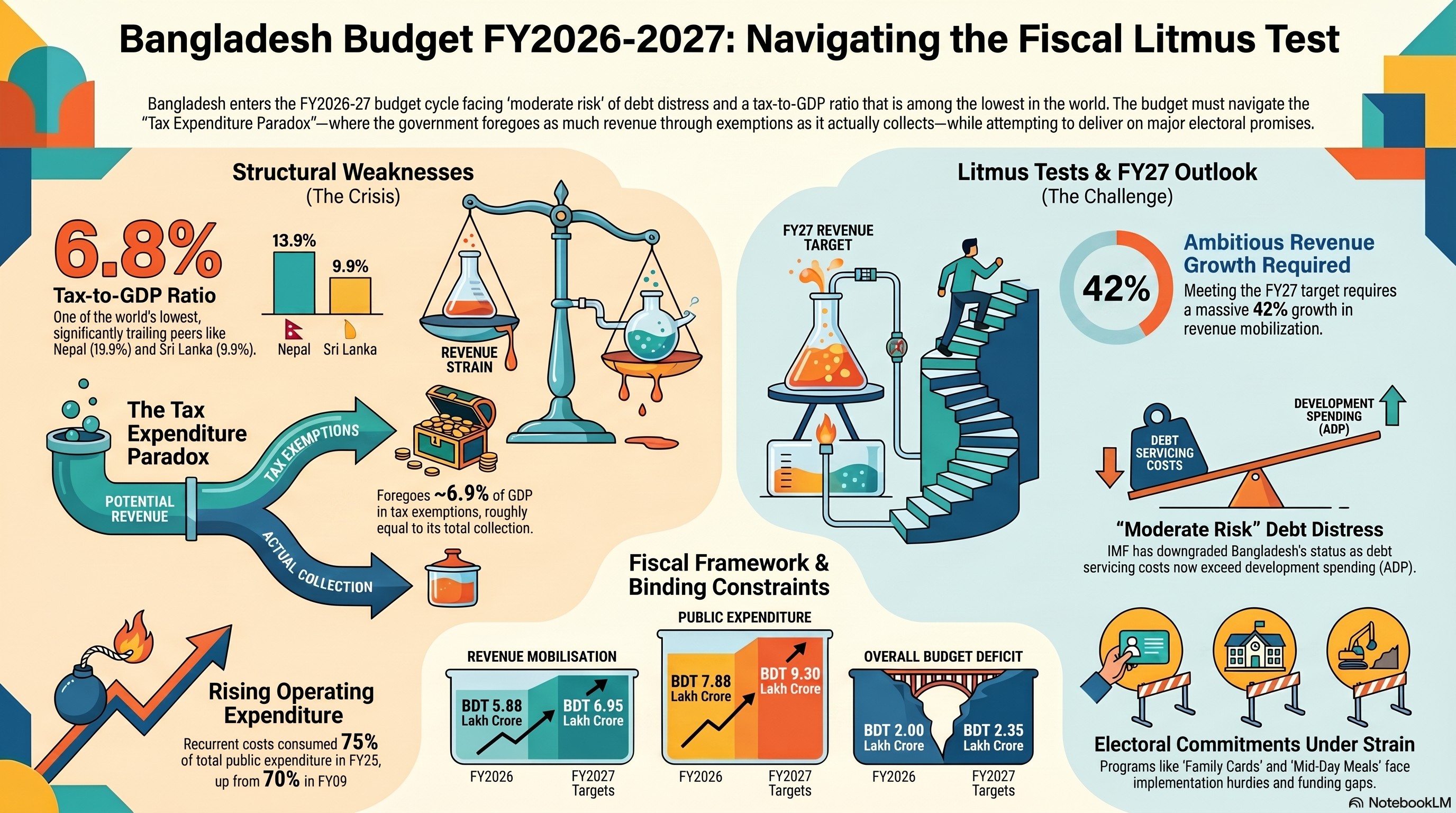
If the nation follows that more realistic 13.4% trajectory, the result will be a BDT 1.3 lakh crore shortfall. This isn’t just a math error; it is a paralysis-in-waiting. Because much of the country’s foreign borrowing is strictly tied to project implementation, revenue serves as the anchor. If revenue mobilization fails, the government’s ability to utilize foreign funds is paralyzed. A “Plan B” is an absolute necessity, as the state will be forced to choose between slashing development or defaulting on service delivery.
4. The Great Trade-Off: Pay Hikes vs. The Marginalized
A profound tension is emerging between the political necessity of public sector satisfaction and the moral imperative of protecting the poor. The Ninth Pay Commission has proposed a salary increase of 100% to 140% for government employees.
The Weight of the Wage Bill Full implementation of this structure would cost an additional BDT 1.06 lakh crore. This is on top of the existing BDT 1.31 lakh crore currently spent on salaries, allowances, and pensions for 14 lakh employees and 9 lakh pensioners, including MPO-listed teachers.
The Subsidy Squeeze This massive, fixed cost—which cannot be undone once rolled out—puts immense strain on the flexible subsidies that protect the marginalized.
- Electricity Subsidies: BDT 37,000 crore is required to prevent production costs from spiraling.
- LNG Subsidies: BDT 25,500 crore is needed to navigate volatile global energy markets.
- Food Subsidies: BDT 9,600 crore is earmarked, yet rising global prices since February 2026 suggest this is a gross underestimate.
“Regrettably, the Ninth Pay Commission report was not made available for independent scrutiny and public disclosure.”
5. The “ADP Baggage”: A Cycle of Revisions
The Annual Development Program (ADP) is increasingly weighed down by what analysts call “ADP Baggage”—a cycle of revisions that signals implementation failure rather than strategic adjustment.
An analysis of 1,352 projects reveals the extent of the rot:
- 54.5% of projects have undergone at least one revision, with some revised up to five times.
- 222 projects have already passed their original implementation dates and are running on “expired” time.
- Flagship failures: Even the nation’s most critical initiatives, such as PEDP-4 (Education) and HNPSP-4 (Health), have become victims of this baggage.
Completing a project without spending its full allocation is rarely a sign of efficiency; it is a sign that the project failed to deliver its promised services on time. This baggage results in:
- Time overruns: Delaying the economic benefits of infrastructure.
- Cost overruns: Draining limited reserves through inflation and mismanagement.
- Delayed service delivery: Directly impacting health and literacy outcomes.
6. Electoral Promises vs. Field Realities
Field assessments of high-profile initiatives—the Family Card, Farmers Card, and Digital Education programs—reveal a chasm between “Official Guidelines” and “Field Observations.”
In the selection for the Family Card, the process was rushed into a narrow five-day window, leading to massive data errors. Many eligible citizens were excluded simply because they did not understand the 814 PMT score threshold. In the digital education sector, the “free Wi-Fi” promise has hit a wall of reality: load-shedding has rendered hardware useless, and teachers are frequently forced to pay for mobile data out of their own pockets to complete official tasks.
Recommendations for Fiscal Realignment:
- Establish an integrated beneficiary database linked to national ID systems to ensure real-time verification and eliminate the exclusion errors seen in the 5-day rush.
- Introduce solar panels and backup power for all schools to ensure that Wi-Fi and multimedia classrooms remain functional during electricity interruptions.
- Decentralize implementation of school supplies by engaging local tailors and small enterprises to ensure proper sizing and timely delivery of uniforms and bags.
- Implement multi-channel grievance redress systems—including offline boxes—to assist the elderly and digitally excluded who are currently ignored by digital-only helpdesks.
7. Conclusion: Beyond the Numbers
As Bangladesh enters FY27, the fiscal framework is at a breaking point. The IMF now classifies the nation’s debt distress as a “moderate risk,” a warning that the days of consequence-free borrowing and unrealistic revenue targeting are over.
The upcoming budget must move beyond the “collection” mindset and embrace the ability-to-pay principle. Rebalancing the tax structure away from a heavy reliance on indirect taxes—which disproportionately hit the poor—is no longer optional; it is a requirement for social and economic stability. Ultimately, the budget’s success will not be measured by the size of the growth “miracle” it promises, but by the “tax justice” it delivers.